
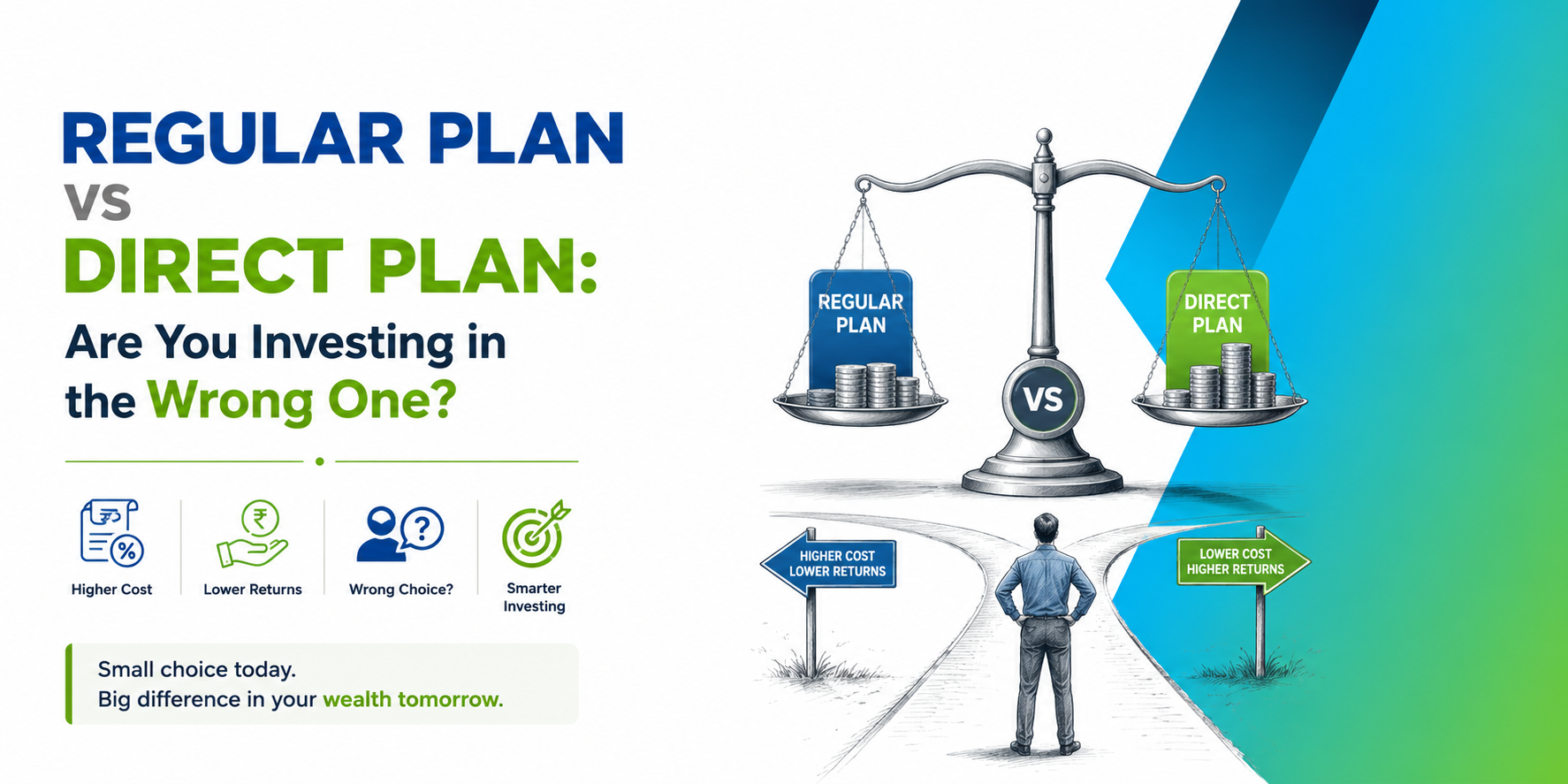
Imagine investing in the same mutual fund as someone else. You both invest ₹10 lakh on the same day. After 20 years, you discover that your friend has accumulated several lakhs more than you—even though you both invested in the exact same scheme.
Sounds surprising?
The difference often comes down to one simple choice: Regular Plan vs Direct Plan.
Many investors don’t even realize they’re invested in a Regular Plan. They simply follow the recommendation of a bank, relationship manager, insurance agent, or distributor without understanding how the plan works.
That doesn’t automatically mean a Regular Plan is bad. In many cases, it provides valuable professional guidance that helps investors avoid costly mistakes.
The real question is:
Are you paying for advice, or are you paying commission without receiving meaningful service?
In this guide, we’ll explain everything in simple language so you can decide which option genuinely fits your investment journey.
What Are Mutual Fund Plans?
Every mutual fund scheme in India is generally available in two versions:
- Direct Plan
- Regular Plan
Both invest in exactly the same portfolio.
For example, if you invest in an equity mutual fund, both plans hold identical stocks in identical proportions.
The only significant difference lies in how you invest and what you pay.
What is a Direct Plan?
A Direct Plan allows investors to purchase mutual funds directly from the Asset Management Company (AMC).
Since there is no intermediary or distributor involved, the AMC does not pay any commission.
As a result:
- Lower expense ratio
- Slightly higher returns over the long term
- Complete responsibility remains with the investor
You select:
- Which fund to buy
- How much to invest
- When to switch
- When to redeem
- Portfolio review
- Asset allocation
Everything depends on your own research and decisions.
What is a Regular Plan?
A Regular Plan is purchased through an intermediary such as:
- Mutual fund distributor
- Financial advisor
- Wealth management company
- Bank
- Investment platform offering advisory services
The AMC pays a commission to the distributor from the scheme’s expense ratio.
In return, investors usually receive services such as:
- Financial planning
- Fund recommendations
- Goal-based investing
- Portfolio reviews
- SIP monitoring
- Rebalancing advice
- Tax planning guidance
- Behavioural coaching during market volatility
This commission does not require a separate payment from the investor. It is already built into the fund’s expense ratio.
Regular Plan vs Direct Plan: Quick Comparison
| Feature | Direct Plan | Regular Plan |
| Purchase Mode | Directly from AMC | Through advisor or distributor |
| Expense Ratio | Lower | Slightly higher |
| Commission | No | Included in expense ratio |
| Investment Advice | No | Yes |
| Portfolio Monitoring | Self-managed | Advisor support |
| Goal Planning | Self | Advisor helps |
| Suitable For | Experienced investors | Most long-term investors |
Why Do Direct Plans Usually Generate Slightly Higher Returns?
The answer is simple.
Since Direct Plans don’t pay distributor commissions, their expense ratio is lower.
Let’s understand with an example.
Suppose:
Regular Plan Expense Ratio = 1.80%
Direct Plan Expense Ratio = 1.20%
Difference = 0.60%
That 0.60% may appear insignificant today.
However, because investments compound every year, this small difference can become substantial over decades.
Example: The Power of Lower Expenses
Investment Amount: ₹10,00,000
Investment Period: 20 Years
Expected Gross Return: 12%
Regular Plan
Net Return after expenses: 10.20%
Future Value: Approximately ₹69 lakh
Direct Plan
Net Return after expenses: 10.80%
Future Value: Approximately ₹78 lakh
Difference:
Nearly ₹9 lakh.
This is why many experienced investors prefer Direct Plans.
But this isn’t the complete story.
Lower Cost Doesn’t Always Mean Better Investing
Many people assume:
“Direct Plan gives higher returns, so everyone should switch.”
Not necessarily.
Successful investing isn’t only about expense ratios.
It is also about:
- Choosing the right fund
- Staying invested
- Avoiding panic selling
- Proper diversification
- Asset allocation
- Tax-efficient withdrawals
A wrong investment decision can easily cost much more than the commission paid in a Regular Plan.
The Hidden Cost of DIY Investing
Let’s say an investor starts investing independently.
Initially everything goes well.
Then:
Markets fall 25%.
News channels predict further crashes.
Social media spreads panic.
The investor exits all equity funds.
After six months, markets recover.
The investor enters again at higher prices.
This single emotional decision could reduce long-term returns by several percentage points.
An experienced advisor often helps investors avoid these mistakes.
Sometimes that guidance is worth far more than the commission.
Understanding Mutual Fund Commission
One of the biggest misconceptions is:
“Regular Plans charge investors separately.”
That’s incorrect.
Here’s how it actually works.
The Asset Management Company deducts the expense ratio from the fund.
A portion of this expense ratio is paid as commission to the distributor.
Investors don’t receive an additional bill.
Instead, the scheme’s returns are marginally lower compared to the Direct Plan because of the higher expense ratio.
This structure is fully regulated and disclosed.
Is Commission a Bad Thing?
Absolutely not.
Commission becomes a problem only when:
- Products are recommended solely because they pay higher commissions.
- Investors receive little or no ongoing service.
- Reviews never happen.
- Financial advice is absent.
On the other hand, commission is completely justified if an advisor provides:
- Goal-based financial planning
- Annual reviews
- Portfolio optimisation
- Tax guidance
- Retirement planning
- Estate planning coordination
- Behavioural coaching
The key is transparency.
Good advisors clearly explain:
- How they earn
- What services they provide
- What investors can expect
Who Should Choose a Direct Plan?
Direct Plans may be suitable if you:
- Understand mutual funds well.
- Can analyse fund performance independently.
- Know asset allocation principles.
- Review your portfolio regularly.
- Stay disciplined during market volatility.
- Have enough time to manage investments yourself.
If all these apply, Direct Plans can help reduce costs over the long term.
Who Should Choose a Regular Plan?
Regular Plans may be better if you:
- Are new to investing.
- Have limited knowledge of mutual funds.
- Want professional guidance.
- Need help planning financial goals.
- Prefer ongoing portfolio monitoring.
- Want assistance with tax-efficient investing.
- Need emotional support during market corrections.
Many busy professionals choose Regular Plans simply because they value expert advice more than the small cost difference.
Common Myths About Direct and Regular Plans
Myth 1: Regular Plans are a Scam
False.
Regular Plans are completely legal, regulated, and offered by every AMC.
The important question is whether you’re receiving genuine advisory services.
Myth 2: Direct Plans Always Make You Richer
Not necessarily.
Lower expenses help.
Poor investment decisions hurt.
Without discipline, Direct Plans can underperform due to investor behaviour.
Myth 3: Advisors Only Sell Products
Good advisors do much more.
They help with:
- Goal planning
- Retirement strategy
- Education planning
- Insurance review
- Tax planning
- Wealth creation
- Portfolio balancing
The investment recommendation is only one part of the overall service.
Myth 4: Switching to Direct Plans is Always the Right Decision
Not always.
Before switching, ask yourself:
- Who will review my portfolio?
- Who will help during market crashes?
- Will I stay disciplined?
- Can I identify underperforming funds?
If the answer is “no,” staying with a good advisor may be the smarter choice.
How to Check Whether You Own a Direct or Regular Plan
It’s easy.
Look at your:
- Mutual fund statement
- CAS (Consolidated Account Statement)
- Investment platform
- AMC account
If the scheme name includes:
“Direct Plan”
You’re invested directly.
If it simply shows the scheme name without “Direct,” it is usually a Regular Plan.
Should You Switch From Regular to Direct?
The answer depends on your situation.
Consider switching if:
- You’re confident managing investments.
- You no longer require advisory support.
- You understand portfolio construction.
- You regularly review investments.
You may continue with Regular Plans if:
- You value expert advice.
- Your advisor actively manages your portfolio.
- They help with financial planning.
- Their guidance improves your investing discipline.
A decision should never be based only on commission.
It should be based on the overall value you receive.
The Wealth Wisdom Difference
At Wealth Wisdom, we believe that investors deserve complete transparency.
We clearly explain:
- How investments work
- How mutual fund commissions operate
- Why certain funds are recommended
- What services you receive
- How your portfolio is monitored over time
Our focus isn’t simply helping you invest.
It’s helping you make informed financial decisions with confidence.
Whether you choose Direct or Regular Plans, the objective remains the same:
Building long-term wealth aligned with your financial goals.
Because the best investment strategy is one you understand, trust, and can stick with consistently.
Frequently Asked Questions (FAQs)
1. Is a Direct Plan always better than a Regular Plan?
Not necessarily. Direct Plans have lower costs, but Regular Plans provide professional guidance that many investors find valuable. The right choice depends on your knowledge, experience, and need for advisory support.
2. Why do Regular Plans have higher expense ratios?
Regular Plans include distributor or advisor commissions within the expense ratio. This covers services such as investment advice, portfolio reviews, and ongoing financial guidance.
3. Can I switch from a Regular Plan to a Direct Plan?
Yes. However, switching is treated as a redemption and fresh investment, which may have tax implications and exit loads. Evaluate these factors before making the change.
4. Does investing through an advisor reduce my returns?
Regular Plans usually have slightly lower returns because of higher expenses. However, quality financial advice can help you avoid costly mistakes, potentially improving your overall long-term outcomes.
5. How do I know if my advisor is adding value?
A good advisor should provide regular portfolio reviews, financial planning, tax guidance, goal tracking, and transparent communication—not just help you purchase a mutual fund.
Final Thoughts
Choosing between a Direct Plan and a Regular Plan is not about finding a universally “better” option. It’s about understanding your own needs as an investor.
If you have the knowledge, discipline, and time to manage your portfolio, a Direct Plan can help you save on costs over the long term.
If you prefer expert guidance, structured financial planning, and someone to help you stay on track through changing market conditions, a Regular Plan can offer value that goes beyond the additional expense ratio.
The most successful investment strategy is one that you understand, remain committed to, and follow consistently over the years.